Cygnus
Cygnus: Notes and Papers of the Vaughan Institute. Founded 1923; second series, 1978. Contents lists of recent numbers are given below; older numbers are being digitised as funds allow. Contributions are welcome and are reviewed by the Keeper and one external reader.
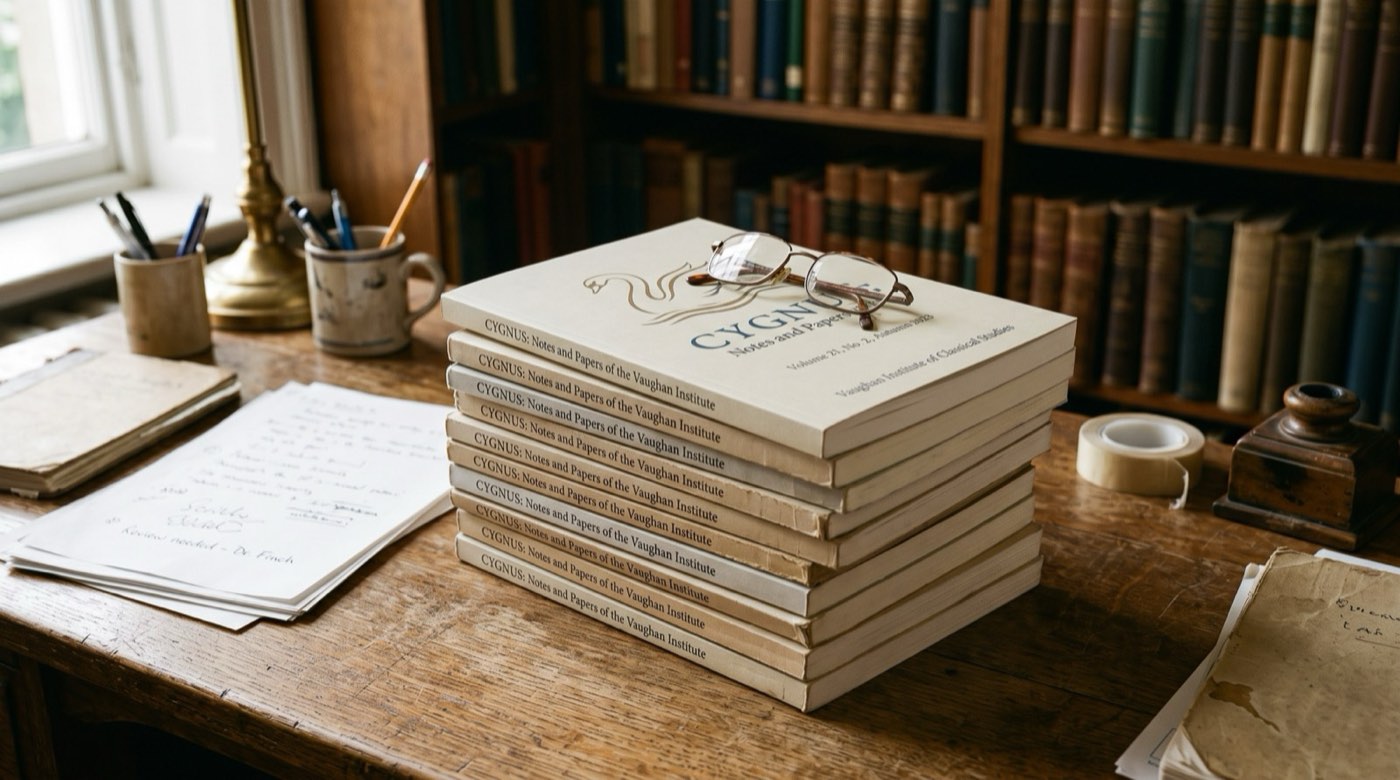
Recent numbers
| n.s. 61 | “The table-sermons of Edward Considine: a fragment recovered.” — digitised below |
| n.s. 60 | “Why the Vessel is closed: the Trustees’ minute of 1931.” — digitised in full, the first complete number online |
| n.s. 58 | “The Trehearne correspondence: a false trail.” |
| n.s. 55 | “On the deviations in the Seals of the Gates.” — digitised below |
| n.s. 52 | “The offices of the Watch: a calendar from candle-ends.” — digitised below |
| n.s. 51 | “War losses of the sealed archive: a reconstruction.” |
| n.s. 47 | “Rent and ritual: the Order’s household accounts, 1811–1917.” — digitised below |
| n.s. 44 | “Six leaves of the Profession: a census of one.” |
| n.s. 41 | “The Considine Diary: what the excised third may have contained.” — digitised below |
| n.s. 38 | “The Vigil Book: a codicological note.” |
“The table-sermons of Edward Considine: a fragment recovered” — by the Keeper. Cygnus, second series, no. 61 (2026)
Excerpt. The manuscript fragment (four leaves, unbound) was acquired with the 1994 accession and has not previously been transcribed in full.
The fragment, four leaves in a clerk’s hand, preserves what the table-sermons alone of Considine’s utterances were: accounts. He preached, witnesses agree, over the candle-ledger itself, and the ledger’s arithmetic was the sermon. It is all one book, the fragment opens, what the chandler sets down and what the soul owes; a reckoning that balances is a prayer said correctly.
The second leaf turns to the familiar figure of the metals. Before the work, the coin; and again: the wax falls as the hour burns, and what remains is owed. Nothing rises in the pan that was not first weighed. The editors observe that Considine nowhere names the planets; the ledger stands for the whole descent.
The last leaf is the most quoted: count the candles, count the hours, count what the fire has taken; the lead of the ledger is the gold of the account. Set beside the Vigil Book’s creeds these lines read almost liturgically; the fragment ends mid-column, the sum unstruck.
“The Considine Diary: what the excised third may have contained” — by the Keeper. Cygnus, second series, no. 41 (1996)
The following excerpt is reproduced from Cygnus n.s. 41, with the passages of the diary quoted therein. Volume IV of the diary (1862–1868) survives complete.
The difficulty with Harriet Considine is not that she conceals, but that she describes with perfect exactness things she declines to name. The entry for 14 June 1863 is characteristic, and I give it in full:
“Kept the vigil from the second hour. The others speak of watching but it is not watching; it is the fly-paper hour, when one is held fast and cannot choose what alights. What came I have written in the other book, in the other hand. N. says the Vessel opens for no hand, only for a habit of the hand, and that I will understand this when I have stopped wishing to. I have not stopped wishing to.”
Three points. First, “the other book, in the other hand” confirms a second diary series, of which no volume survives, and suggests the excision of volumes II and III was of a piece with its keeping. Second, “N.” appears eleven times in volume IV and is nowhere expanded; the Vigil Book offers three candidates and I decline to choose in print. Third — and this the paper’s argument — her figure of the fly-paper hour recurs in the ritual papers of the sealed archive in a form that shows it was not private to her: it had become, by the 1880s, the Order’s own term for the state the second station induces. When a society borrows a member’s private image for its liturgy, the member has usually written the liturgy. I believe Considine wrote a great deal more of the late ritual corpus than the register’s single Keepership implies, and that the missing volumes were removed precisely because they showed it.
“On the deviations in the Seals of the Gates” — by D. R. Mostyn. Cygnus, second series, no. 55 (2011)
Excerpt; the paper’s plates are available in the catalogue records of VI.1919.12–18.
Set any of the seven Seals beside its exemplar in the Solomonic manuscripts and the eye reports a good copy. Measure, and the report collapses. In every Seal the characters within the inscribed square stand in the wrong cells — wrong, that is, by the manuscripts, but wrong identically: the displacement of any character can be predicted from the displacement of any other, in all seven, by a rule I can exhibit but not explain. The engraved line that wanders through each square — which the exemplars do not possess at all — visits the displaced cells in a fixed order, entering and leaving each Seal’s square at points that correspond across the set.
Two conclusions may be drawn safely. The Seals were engraved from a single scheme, by an engraver following instructions he need not have understood; and the scheme is arithmetical, not decorative. A third conclusion I resisted for some years and now merely postpone: that the wandering line is not an ornament upon the square but a reading of it, and that the Order did not display these objects to be admired. They are exercises. The question the paper cannot answer is what faculty they exercise, since the Order examined its candidates, by its own account, in nothing so wholesome as arithmetic.
“The offices of the Watch: a calendar from candle-ends” — by J. Feather. Cygnus, second series, no. 52 (2008)
Excerpt. A continuation of the household-accounts work of Number 47.
The accounts, it will be remembered, buy candles in bulk each quarter-day and at no other time. What the earlier paper did not ask is what the candles were for, and the answer is in the wax: the chandler’s receipts distinguish seven grades by weight, purchased in fixed proportion, quarter upon quarter, for a century. Seven grades, seven offices. The Watch was not a vigil but a rota — seven distinct observances, each with its own light, kept in a fixed round.
The offices are named nowhere in the accounts, but the ritual papers give them, carelessly, in the plural: the offices are those of the seven wandering stars, and the round is the week — not our week of habit, but the week as the ancients derived it, by the star drawn point to point across the ring of the planets in their old order. The derivation is in every history of astrology and I will not rehearse it; it is enough that the Order’s week, like everyone’s, began with Saturn, and that a member who could see the ring could always find the round.
One further item from the wax. The 1874 inventory of the meeting-rooms lists “the bell-book of the offices,” and the bell-book, which survives in the sealed archive, gives seven tones — one to an office, in the order of the round — and no eighth. Whatever was sung or struck in Lammas Court, it was sung or struck seven times, in an order the Order considered too obvious to write down. The accounts, as usual, agree: there is no invoice for an eighth candle.
“Rent and ritual: the Order’s household accounts, 1811–1917” — by J. Feather. Cygnus, second series, no. 47 (2003)
Excerpt. The accounts are the best-preserved class of document in the sealed archive and may be consulted in full by arrangement.
Societies of the Order’s kind are studied through their doctrines because their doctrines survive; their ledgers, which survive less often, are the better witness. The Order paid £28 per annum for its rooms in 1811, £85 by 1901, quarterly, by banker’s draft, never late in one hundred and six years. Candles are bought in bulk each quarter-day and at no other time, from which the calendar of the Watch can be reconstructed more securely than from any ritual paper. Refreshment appears once yearly, modestly. In 1893 the accounts record nine shillings “to the glazier, for the window broke at the equinox,” and the ritual papers record nothing at all, which is the usual proportion between what happened and what was written down.
The last entries are the strangest in their ordinariness. The rent was paid through Lady Day 1919 on rooms the register shows the Order never entered after October 1917. Someone was discharging the obligations of a body that had ceased to exist, punctually, for six quarters, and the accounts do not say who, because accounts never do.